A concrete roof may look ready for waterproofing once visible cracks are repaired and the surface has been cleaned. However, if rainwater still remains on the slab long after rainfall has stopped, applying a new coating or membrane may not solve the underlying problem.
Before carrying out concrete roof waterproofing in Kota Kinabalu, ponding water should be assessed together with the roof fall, drainage outlets and substrate condition. Standing water affects how a waterproofing system performs and may place additional stress on coatings, joints and roof details.
The question is therefore not only, “Where is the leak?” It is also, “Why is water remaining on the roof?”
Ponding Water Changes the Waterproofing Requirement
Ponding water is not the same as temporary wetness after rain. A concrete roof may remain damp for a short period, especially around rough screed or shaded areas. The concern begins when water repeatedly collects in low spots, around outlets, beside parapet walls or along uneven screed depressions.
For an exposed concrete roof, ponding water increases the demand on the waterproofing system. The membrane or coating may be exposed to longer water contact, dirt accumulation, algae growth and repeated heating and cooling around the waterline. If the waterproofing material is not designed for that condition, it may soften, blister, lose adhesion or deteriorate faster than expected.
Before concrete roof waterproofing, ponding water should be treated as a drainage and substrate issue, not only a surface waterproofing issue. If water remains in low areas after normal drying time, the roof fall, outlet condition and screed level should be checked before applying a new waterproofing layer.
This is particularly important for flat and low-slope concrete roofs that depend on roof outlets, scuppers and downpipes to remove rainwater efficiently.
A Low Spot Can Be More Critical Than a Visible Crack
When a roof leaks, cracks often receive the most attention. Cracks are important, but they are not always the full explanation. A small crack in a dry, well-drained area may be less risky than a low spot where water sits for hours or days after every rain.
Ponding areas create longer water exposure around some of the most vulnerable roof details, including construction joints in the concrete slab, wall-floor junctions at parapets, pipe penetrations and sleeves, old repair patches, membrane laps or terminations, and outlets with weak sealing around the opening.
If water repeatedly rests over these details, it increases the chance of water entering through small defects. The leak may then appear somewhere else below because water can travel along the slab, screed interface or embedded services before becoming visible indoors.
This is why a roof inspection should not only mark visible cracks. It should also trace where rainwater naturally flows, where it slows down, and where it stops. A dry-weather inspection can miss this unless water marks, dirt rings, algae staining or tide lines are read correctly.
Why Recoating Over Ponding Water Areas Can Fail Early
A common assumption is that applying a thicker waterproof coating will solve the problem. It may improve protection in some situations, but thickness alone cannot correct poor drainage. If the roof surface continues to hold water, the waterproofing layer remains under higher stress.
Recoating over ponding areas can fail for several reasons. First, trapped moisture below the existing coating or screed can turn into vapour pressure when the roof heats up. This may cause blistering or peeling. Second, dirt and biological growth in ponding zones can weaken adhesion if surface preparation is incomplete. Third, if the screed is already weak, powdery or hollow, the waterproofing layer may bond to a surface that later separates from the slab.
There is also a detailing issue. Many roof coatings perform well as exposed waterproofing when water drains away, but not all coatings are suitable for continuous or frequent standing water. Some systems require a minimum fall, additional protection, or a different build-up when ponding cannot be fully eliminated.
The practical point is simple: the waterproofing product should not be asked to compensate for a roof profile that keeps water in the wrong places.
What Should Be Checked Before Waterproofing a Concrete Roof?
A useful inspection starts with water behaviour. After rainfall, observe where water remains, how deep it is, and whether it drains away naturally or disappears mainly through evaporation. This pattern can help determine whether the problem comes from a small local depression or a broader issue with the roof fall.
The inspection should then connect ponding locations with nearby roof details. Water collecting beside a parapet may indicate insufficient fall away from the wall, while water around an outlet may be caused by a raised outlet lip, blocked strainer, restricted discharge path or settlement around the drain. Ponding in the middle of the roof may indicate uneven screed, local depression or slab movement.
Before waterproofing begins, the roof should be checked for adequate fall towards the outlets, while outlets, scuppers and downpipes should be inspected to confirm that they are clear and correctly positioned. The outlet edge should also sit lower than the surrounding roof surface so that water can drain effectively. At the same time, the existing screed should be checked for hollow, cracked, powdery or debonded areas, and any old waterproofing should be inspected for peeling or poor adhesion. Particular attention should be given to ponding areas that overlap construction joints, pipe penetrations, parapet junctions or previous repair patches.
These checks should be completed before selecting and applying the waterproofing system. If significant ponding or drainage problems are only discovered after coating work has started, the project may require additional repairs, increased cost or a change in the waterproofing scope.
When Ponding Water Can Be Corrected
Not every ponding issue requires the same response. A shallow local depression may be corrected by proper surface preparation and local levelling before waterproofing. If the outlet is the problem, improving the drain detail may be more effective than coating the entire roof again. If the roof fall is generally wrong, a new screed to create proper slope may be necessary before the waterproofing system is installed.
However, some buildings have constraints. Raising floor levels may affect door thresholds, parapet heights, equipment bases or access covers. Adding screed increases load and may require structural consideration. Installing new outlets may not be simple if the building is occupied or if drainage routes are limited.
In such cases, the decision becomes a trade-off. The roof owner may need to choose a waterproofing system that can better tolerate intermittent standing water, while also reducing ponding as much as practical. The limitation should be clearly understood: managing ponding is not the same as eliminating it.
If ponding water cannot be fully removed, the waterproofing specification should state that condition clearly. The selected roof waterproofing system must be checked for suitability under intermittent standing water, and vulnerable details such as outlets, parapets and penetrations should receive additional attention.
Drainage Should Be Checked Before the Waterproofing Build-Up
A sound concrete roof waterproofing plan normally follows this sequence: identify water flow, correct drainage defects where possible, prepare the substrate, detail vulnerable areas, then apply the waterproofing system according to specification.
Skipping the drainage step can make the rest of the work less reliable. For example, sealing cracks before checking roof fall may hide symptoms without addressing why water concentrates there. Applying a new coating over old, weak material may only transfer the failure to the old layer underneath. Treating the main roof area but leaving outlet detailing unchanged may allow leakage to continue at the most stressed point.
For concrete roofs in Kota Kinabalu, roof waterproofing should be planned around actual site behaviour after rain, not only around a dry surface inspection. The best repair scope may be a combination of drainage correction, substrate repair, joint treatment and a compatible waterproofing system.
QingLong Waterproofing supplies and applies waterproofing systems for residential, commercial and industrial projects, including concrete roof applications. Where ponding water is present, the suitable approach should be assessed based on roof fall, substrate condition, exposure and drainage details rather than product choice alone.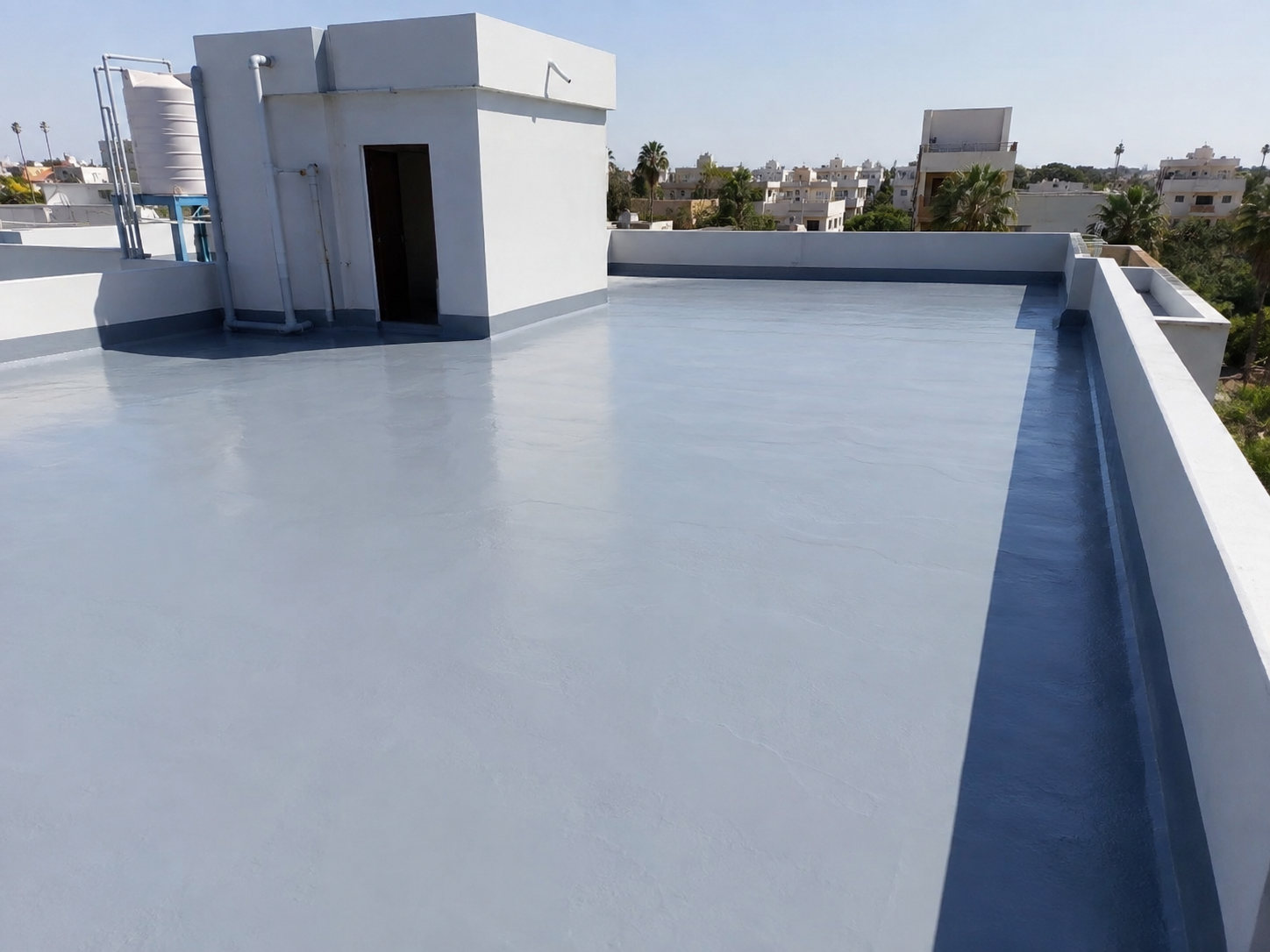
Conclusion
Ponding water is a warning that the roof surface and drainage system need to be understood before waterproofing begins. A new coating or membrane may stop water penetration only if the substrate, roof fall and drain details allow the system to perform properly.
Before approving concrete roof waterproofing in Kota Kinabalu, check where water remains after rain, why it remains there, and whether the condition can be corrected or must be managed in the specification. If ponding water is part of your roof problem, you can discuss your site condition with QingLong Waterproofing for a suitable recommendation.
Frequently Asked Questions (FAQs)
1. What is ponding water on a concrete roof?
Ponding water is rainwater that remains in low areas of the roof instead of draining away properly. It often appears around roof outlets, parapets or uneven screed.
2. Should ponding water be fixed before waterproofing?
Yes. The cause of ponding should be checked before applying a new waterproofing system. Poor roof fall, blocked outlets or uneven screed may need to be corrected first.
3. Can waterproof coating stop ponding water?
No. Waterproof coating can help prevent water penetration, but it cannot correct poor drainage or an uneven roof surface.
4. Why can ponding water damage waterproofing?
Standing water keeps the waterproofing layer wet for longer periods and can increase the risk of blistering, peeling, algae growth and loss of adhesion.
5. How can ponding water on a concrete roof be reduced?
Depending on the cause, ponding may be reduced through local levelling, screed correction, outlet improvement or better roof drainage.