A leaking tiled roof does not always mean the tiles must be replaced. It also does not mean a waterproof coating will solve the problem. In many Central Melaka properties, especially older terrace houses, shoplots and renovated homes, the real decision is whether the roof tiles are still performing as a water-shedding system, or whether the roof build-up has deteriorated beyond what coating can reasonably protect. Before spending on tile roof waterproofing in Central Melaka, the roof should be assessed as a complete system: tiles, ridges, valleys, flashings, underlay, gutters, battens and roof penetrations.
The First Question Is Whether the Tiles Are Still Doing Their Job
Roof tiles are not normally meant to work like a flat waterproof membrane. They shed rainwater by overlapping each other on a slope. If the tiles are correctly aligned, securely fixed and supported by a sound roof structure, water should flow down the roof face into gutters without entering the roof space.
That is why coating a tiled roof is not the same decision as coating a flat concrete roof. A coating can help protect and seal a suitable roof surface, but it cannot correct all defects in a tile system. If tiles have slipped, cracked, opened at laps or lost proper support, water may enter beneath the tile layer before any surface coating can help.
For tile roof waterproofing in Central Melaka, this matters because many properties are not new roofs with clean, uniform tile layouts. Some have extensions, changed gutters, patched valleys, added skylights, solar brackets, air-conditioning penetrations or old ridge repairs. These details often leak before the main tile surface does.
A tiled roof can usually be coated only when the tiles are stable, well-aligned, properly lapped and strongly bonded to the substrate or fixing system. If many tiles are cracked, loose, badly weathered or supported by deteriorated battens, replacement or partial rebuilding should be considered before waterproof coating.
When Coating the Tile Roof May Be a Reasonable Option
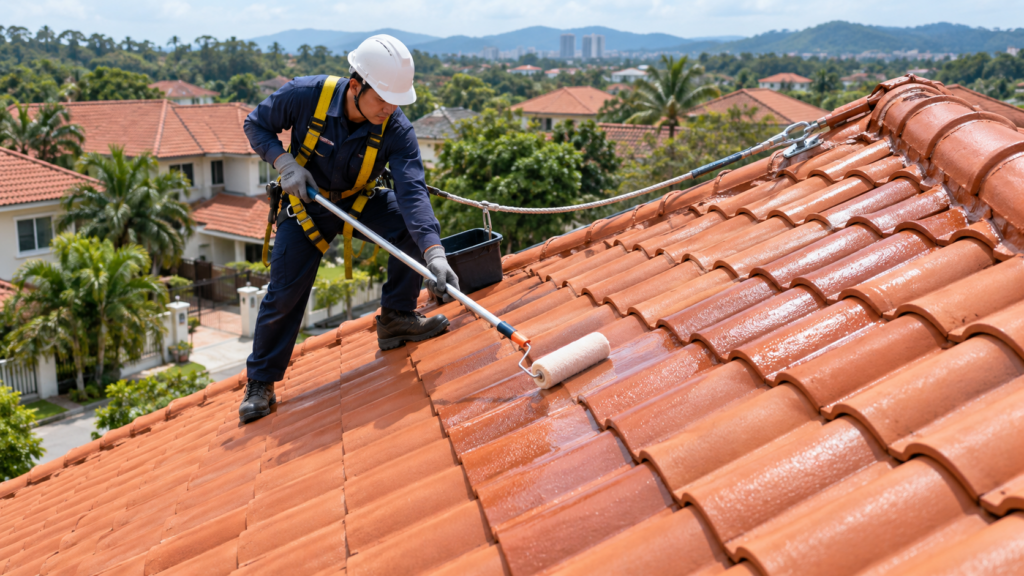
Coating may make sense when the roof tiles are still structurally serviceable, but the surface has become porous, worn or vulnerable to water absorption. This is more likely where the roof slope is still correct, the tiles have not shifted, and the leak is related to surface ageing or minor hairline defects rather than major movement.
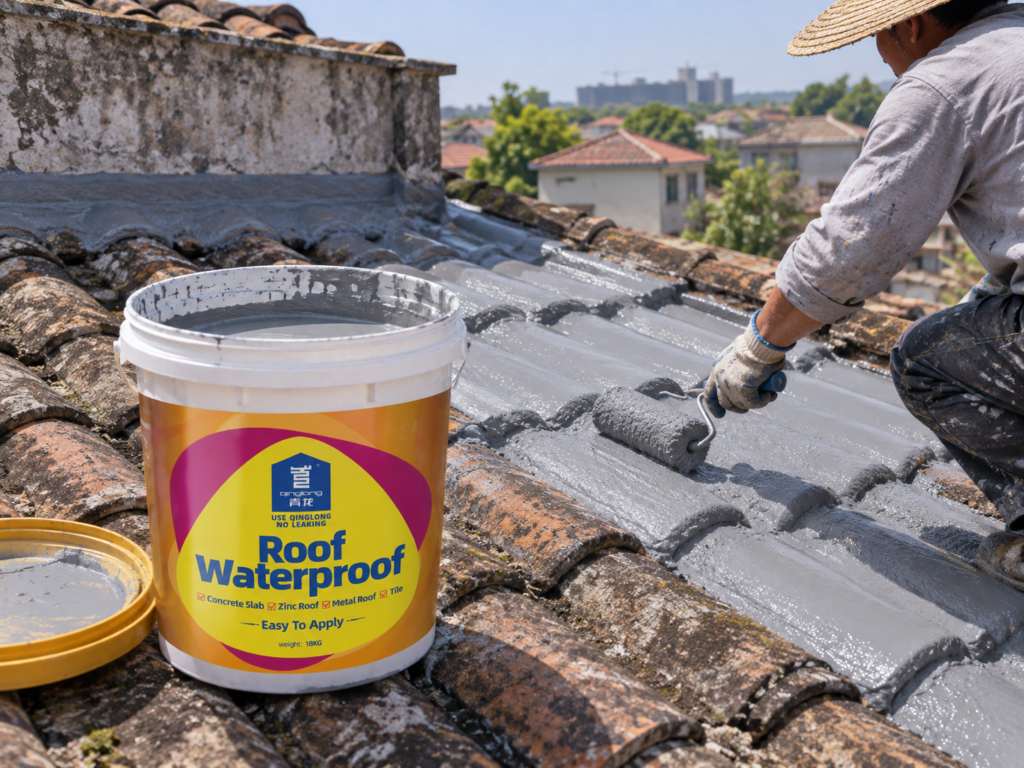
A suitable roof coating can help reduce water absorption, improve weather resistance and extend the serviceable life of the roof surface, subject to product suitability and correct preparation. QingLong’s QL-Roofing Waterproof Coating, for example, is intended as a weather-resistant roof coating, but it should still be applied only after the roof condition is checked. The product does not turn broken tiles, failed flashing or rotten roof support into a sound system.
Coating is more likely to be practical when:
• The roof tiles are generally intact, with only isolated cracks or small local defects.
• Ridge capping and roof edges can be repaired before coating.
• The tile surface can be properly cleaned without damaging the roof.
• Existing coatings, moss, dirt or powdery surfaces can be removed or stabilised.
• Gutters, valleys and downpipes are working and not causing backflow.
• The roof slope allows water to discharge instead of ponding.
Surface preparation is especially important. A coating applied over dust, biological growth, loose previous coating or damp contaminated tiles may peel or blister. The roof may look freshly repaired for a short period, but the water path remains unchanged.
When Replacing Tiles Is Safer Than Coating Over Them
Replacement becomes the better decision when the roof tiles are no longer reliable as a water-shedding layer. In this situation, coating may only hide the deterioration temporarily.
A roof with widespread cracked tiles, soft or delaminating clay/concrete surfaces, missing corners, unstable ridge caps or many previous patch repairs should not be treated as a simple coating job. If water is entering through the overlaps, under cracked valleys or around failed flashing, coating the visible tile surface may miss the actual entry point.
Tile replacement may also be necessary when the support beneath the tiles is compromised. Loose battens, rusted metal supports, sagging timber, damaged underlay or poor fixing can allow the tiles to move during wind and rain. Even if a coating initially bonds, movement at the tile laps or ridge line can reopen gaps.
One risk with coating a badly deteriorated tiled roof is false confidence. The owner may delay proper repair while water continues to affect ceilings, timber, insulation or electrical areas below. Once moisture has travelled along rafters or ceiling boards, the visible stain inside the property may appear far away from the actual roof defect.
In Central Melaka, another practical issue is access. Where roofs sit close to neighbouring properties, or where a rear extension has a complicated roof junction, replacing only the damaged tile area may be safer than applying a full coating without being able to inspect every lap, gutter and wall abutment properly.
The Details Around the Tiles Often Decide the Repair Scope
Many tiled roof leaks do not come through the middle of a tile. They occur at details where the roof system changes direction or meets another building element.
Ridge caps are a common example. If the mortar bedding or sealant at the ridge has cracked, water may enter at the highest part of the roof and travel downward under the tiles. Coating the main roof plane while leaving a weak ridge detail untreated can result in recurring leakage.
Valleys are another important area. A valley collects water from two roof slopes. If it is narrow, blocked, corroded, poorly lapped or filled with debris, rainwater can overflow sideways beneath tiles. In that case, the issue is drainage capacity and valley detailing, not simply tile porosity.
Wall flashings and parapet junctions also need attention, especially on shoplots, terrace houses and buildings with extensions. Where a tiled roof meets a vertical wall, water must be directed away by proper flashing and termination. A coating that stops at the wall face without treating the junction may leave the main leak path open.
Before deciding to coat or replace tiles, the inspection should look closely at:
• Ridge caps, hip caps and mortar bedding
• Valleys, gutters and downpipe discharge
• Wall abutments and flashing termination
• Pipe penetrations, brackets and roof-mounted equipment
• Cracked, slipped or uneven tile rows
• Signs of water entry inside the roof space
These details help determine whether the roof needs coating, local tile replacement, flashing repair, ridge treatment or a larger roof renewal scope.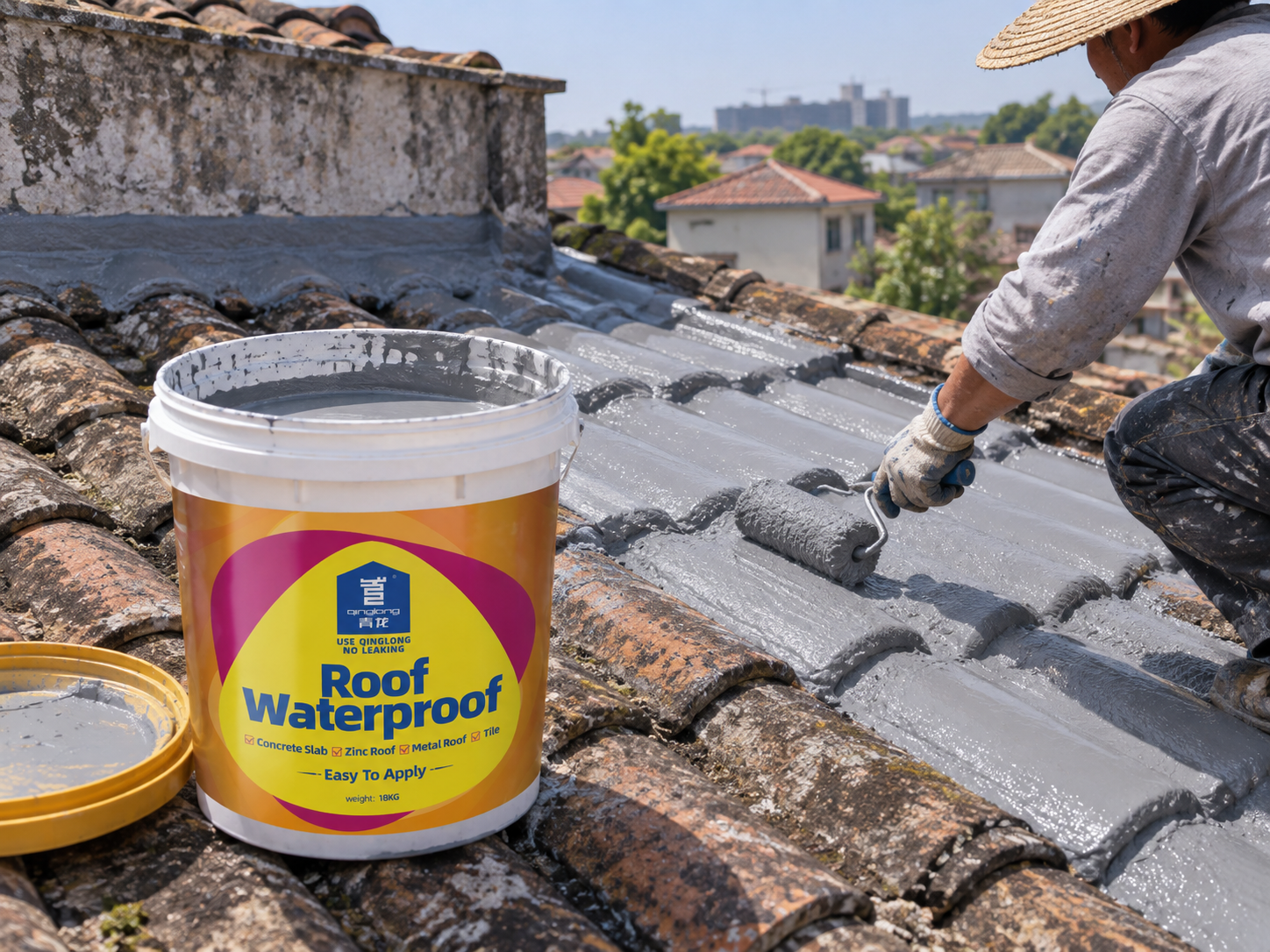
Why “Coat Everything” Can Be the Wrong Shortcut
A full roof coating can look like a simple answer because it covers a large visible area. But on a tiled roof, more coverage is not automatically better. Tiles need proper laps and drainage paths. If coating is applied too heavily across joints without considering movement and water flow, it may crack at the overlaps or interfere with how the roof sheds water.
Another problem is moisture trapped beneath previous repairs. Some old tiled roofs have been patched many times with sealant, cement, membrane strips or unknown coatings. Applying a new coating over incompatible materials may reduce adhesion. The new layer may fail not because the coating is poor, but because the substrate was not suitable.
This is why tile roof waterproofing should not be specified only by roof area. The condition of the tile surface, the type of existing coating, the drainage details and the leak history all affect the correct method.
For a still-sound tiled roof, a roof coating system may be part of preventive maintenance. For a roof with widespread broken tiles and failed detailing, coating is more likely to become a temporary cosmetic layer. The money may be better spent on replacing damaged tiles, repairing flashings and restoring proper water discharge before any protective coating is considered.
A Practical Decision Framework for Central Melaka Property Owners
The decision does not have to be “coat the entire roof” or “replace everything”. Many roofs need a mixed repair scope.
If the leak is localised near a ridge, valley or wall junction, the first step may be to repair that detail and replace nearby damaged tiles. If the tiles are generally sound but porous, coating can then be considered as an added protective layer. If the whole roof has unstable tiles, poor support and repeated leakage from different areas, replacement or more extensive roof repair should come first.
For occupied homes or commercial premises in Central Melaka, disruption also matters. A coating job may be faster than tile replacement, but speed is not helpful if the wrong defect is being treated. On the other hand, replacing tiles unnecessarily can increase cost and disturbance when the roof only needs targeted repairs and a compatible protective coating.
The better question is not “Which option is cheaper?” but “Which option addresses the actual water path?” Once the water entry route is understood, the repair method becomes clearer.
QingLong Waterproofing can assist with assessing tiled roof conditions and recommending a suitable repair or coating approach based on the roof surface, details and leak pattern. If you are unsure whether your tiled roof should be coated or repaired first, you may contact QingLong Waterproofing for a site discussion.
Conclusion
A tiled roof should be judged as a water-shedding system, not just as a surface to be painted. Coating is suitable only when the tile roof is stable enough to receive and retain the waterproofing layer. If the tiles, ridges, valleys, flashings or supports have already failed, replacement or detail repair must come first. For tile roof waterproofing in Central Melaka, the most reliable decision is made after confirming whether water is entering through tile porosity, defective details or structural deterioration beneath the tiles.